
COMPARATIVE TASTING
The closure that defines the wine
Without filters project
April 2026
Without Filters is a J·VIGAS project born from a simple idea: to open a conversation about the influence of the closure on wine evolution.
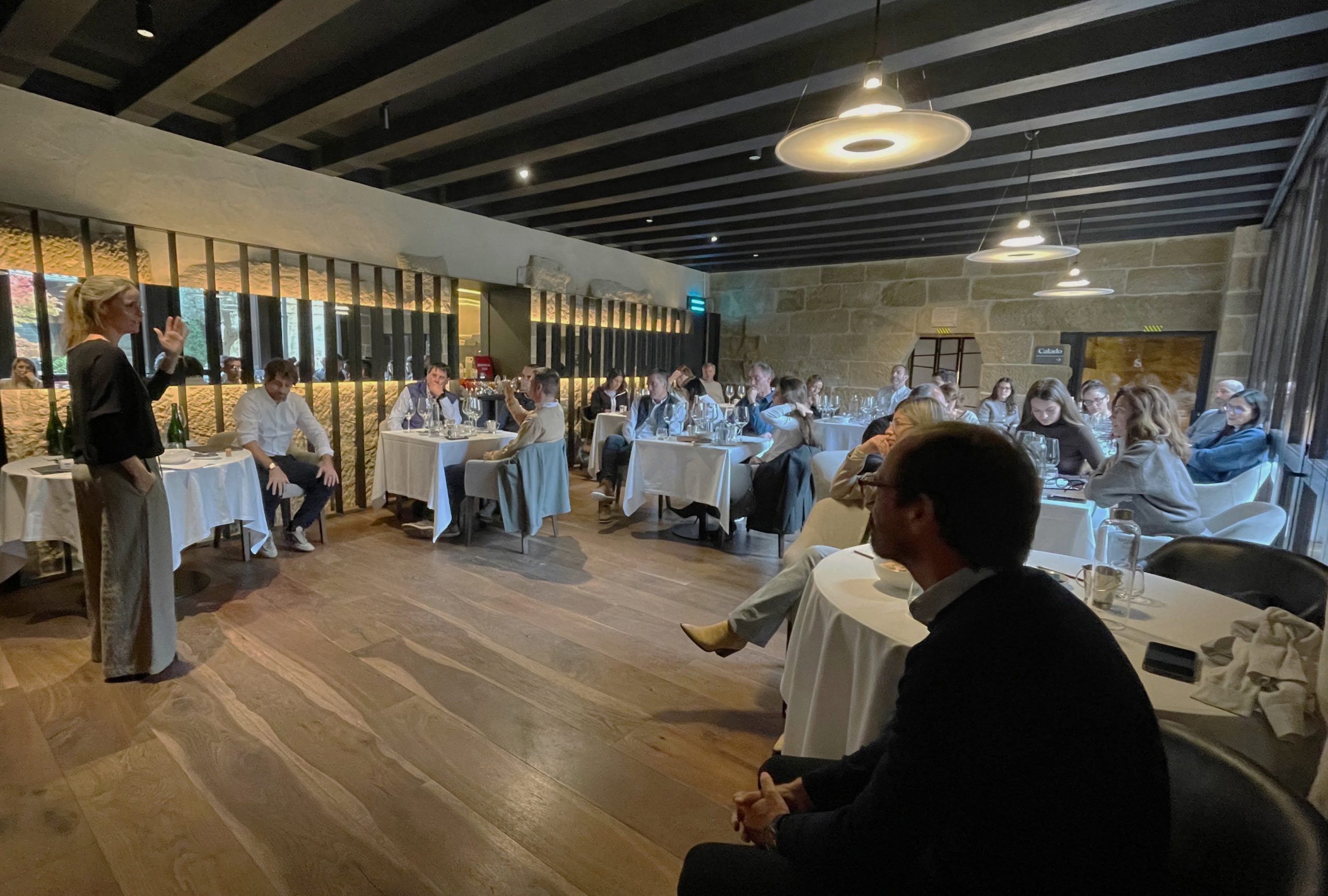
The project takes the form of comparative tastings and gatherings with winemakers and wine professionals. Wines are tasted in which the closure is the only variable that changes, allowing participants to observe what happens as the wine has time to evolve.
Over the past months, Without Filters has reached different wine regions, with gatherings in Catalonia, Rioja, Burgundy and Ribera del Duero, always in small groups of professionals.
The aim is not to start from a conclusion, but to put the wine in the glass and let the experience open the conversation.
The methodology consisted of comparing different bottles of the same wine—same base, same production and same ageing period—altering only the type of closure used: natural cork and technical closure. The tests were carried out at different stages after bottling: three months, six months and one year.
As Raúl Vigas explains: “When we isolate the closure factor and keep all other variables constant, the impact on the wine’s evolution becomes extraordinarily evident. These are nuances that are often not perceived in the short term, but emerge clearly as the wine begins to develop in bottle.”
During the sessions, participating winemakers observed that samples sealed with natural cork showed a more complex and harmonious evolution in the glass, with greater aromatic depth and a sense of progressive development. By contrast, wines sealed with technical closures appeared more linear—technically correct, but with a more restrained sensory expression.
Moreover, the longer the time in bottle, the more evident this difference became.
Beyond the organoleptic results, we highlight the value of these tastings as a tool for observation and learning for wineries. “What was truly striking was not only the difference in the glass, but the reaction of participants: the initial silence, the surprise, and the immediate reflection on how small decisions at origin can significantly shape the final outcome of the wine,” notes Vigas.
From a broader perspective, Raquel de Nadal, Director of Sustainability and Innovation, emphasises that this type of analysis is closely aligned with a philosophy of continuous improvement: “Innovation does not always mean introducing new processes or complex technologies; sometimes it means taking the time to observe more deeply elements that have always been there and better understanding their real impact on the final product.”
For this reason, we have begun conducting studies on clients’ wines, fully aware of the impact that the choice of closure can have on their evolution, and we welcome any winery interested in carrying out these comparative tastings with their own wines.
These experiences reinforce an increasingly shared idea among producers and technicians: wine is not fully defined in the winery, but continues to evolve silently in bottle, where the closure acts as a determining factor in its development.
In a context where excellence is increasingly built on detail, studying closure performance ceases to be a secondary matter and becomes a strategic variable in the final quality of the wine.